
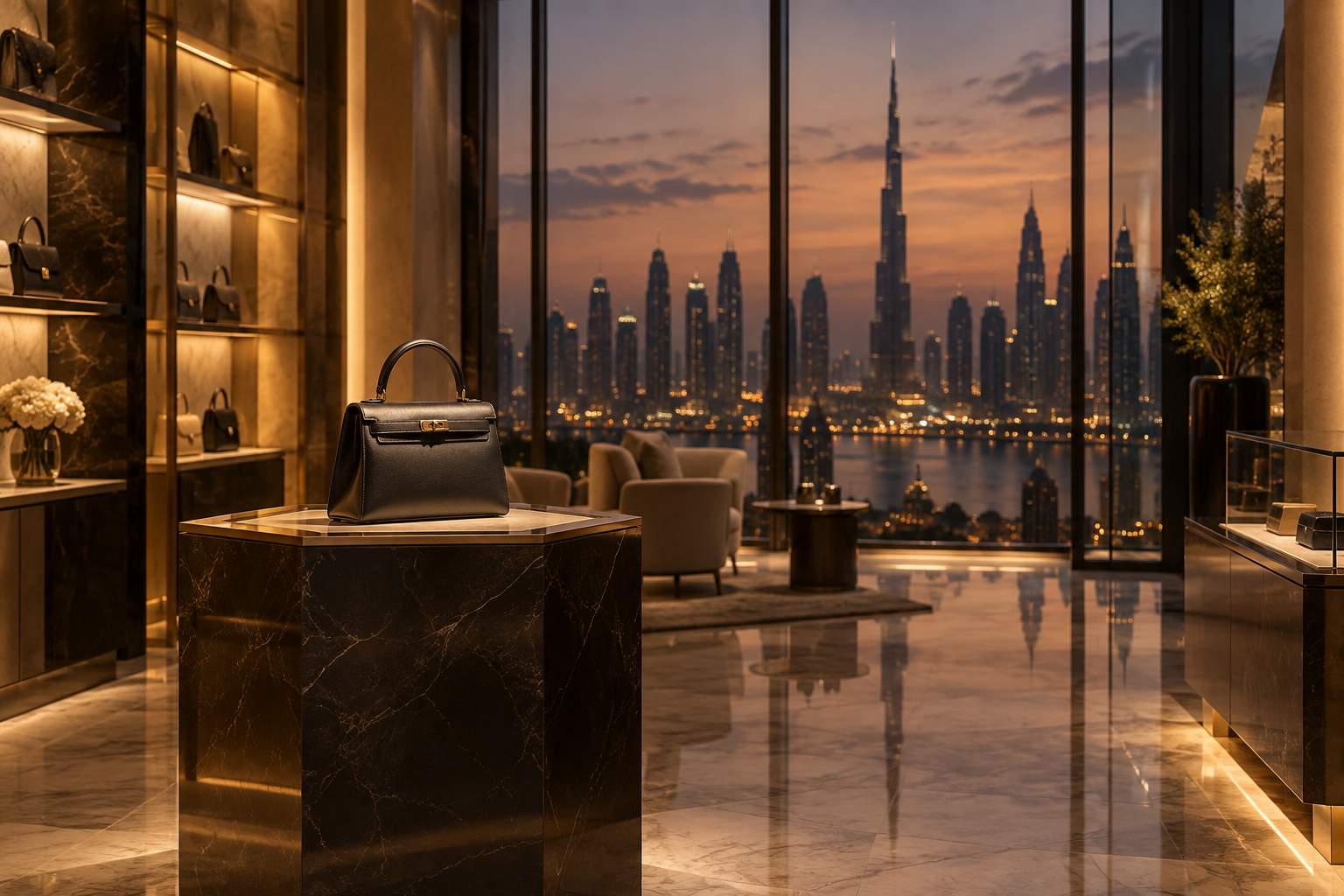
Walk through The Dubai Mall on any given evening and you'll notice something: the brands with the longest queues rarely have a sale sign in sight. Chanel doesn't discount. Cartier doesn't run a flash sale. The watch boutiques along Fashion Avenue don't send "20% off, today only" emails. Yet these brands consistently outsell mass-market competitors who discount constantly. This isn't luck — it's luxury brand marketing dubai done correctly, and it's a completely different discipline from the growth-hacking playbook most agencies default to.
The UAE has one of the highest concentrations of high-net-worth individuals per capita in the world, and Dubai in particular has built its entire retail and hospitality economy around premium positioning. For brands operating in this market — whether in fashion, real estate, hospitality, jewellery, F&B, or professional services — the temptation to discount when sales dip is constant. Resisting that temptation, and building the marketing infrastructure that makes discounting unnecessary, is the actual job of a luxury marketing agency uae businesses should be hiring.
Why Discounting Destroys the Thing Luxury Buyers Are Paying For
Luxury pricing isn't a reflection of production cost — it's a reflection of scarcity, craftsmanship narrative, and social signalling. When a brand discounts, it doesn't just lose margin on that transaction. It permanently recalibrates what customers believe the product is worth. A handbag that was AED 18,000 last month and AED 12,000 this month via a "VIP preview sale" tells every future buyer that AED 12,000 was always the real price, and AED 18,000 was a markup waiting to be corrected.
In the GCC specifically, where word-of-mouth within tight social circles moves faster than any ad campaign, this recalibration spreads quickly. A single visible discount at a Dubai boutique can undercut full-price sales across the entire GCC region within weeks, because affluent shoppers in Riyadh, Doha, and Kuwait City are watching Dubai pricing as the benchmark.
The Data Discounting Hides
Brands that chase short-term revenue through markdowns often see a temporary spike in units sold, then a longer-term decline in average order value and repeat full-price purchases. A premium brand strategy dubai approach tracks different numbers entirely: waitlist length, referral rate from existing clients, and the ratio of full-price to promotional sales — because those numbers predict long-term brand health far better than a single quarter's revenue chart.
What Replaces the Discount: Scarcity Engineered on Purpose
The alternative to discounting isn't "do nothing and hope." It's deliberately engineering scarcity so that demand outpaces supply in a way customers can see and feel. This is standard practice among luxury automotive and watch brands in Dubai — limited production runs, invitation-only previews, and waitlists that are genuinely capped rather than manufactured for show.
For smaller and mid-sized premium brands in the UAE — a boutique fragrance house, an independent jewellery designer, a members-only F&B concept — the same principle applies at a smaller scale. Limited drops, capacity-capped reservations, and "by invitation" access to new collections all create the same psychological effect as a hypercar waitlist, just calibrated to the brand's actual size.
Controlled Distribution Over Wide Reach
Mass-market marketing optimises for reach — get the message in front of as many people as possible. Luxury marketing optimises for the right people, and deliberately excludes everyone else. This means being selective about which retail partners carry the product, which influencers are given access, and even which advertising placements are used. A billboard on Sheikh Zayed Road might build awareness, but it can also dilute exclusivity if the brand's actual customer never needed mass awareness to begin with.
PR Before Performance: Earning Coverage Instead of Buying Clicks
For premium brands, editorial credibility does work that paid advertising cannot. A feature in Gulf Business, a mention in Vogue Arabia, or a profile in Khaleej Times' lifestyle section carries a third-party endorsement that no Instagram ad, however polished, can replicate. This is where luxury PR dubai strategy becomes the backbone of the entire marketing plan rather than a side activity bolted onto performance ads.
Good luxury PR in the UAE isn't about blasting a press release to every journalist on a database. It's about building relationships with the specific editors and tastemakers who cover a brand's category, understanding their editorial calendars months in advance, and pitching stories — a founder's craftsmanship philosophy, a rare material sourced from a specific region, a collaboration with a regional artist — that are genuinely newsworthy rather than thinly veiled advertisements.
Events as Media, Not Just Guest Lists
Dubai's calendar is dense with launch events, but the ones that generate lasting brand equity are the ones designed as media moments first and guest-list flexes second. A product reveal at a private villa in Emirates Hills, documented through professional photography and a short cinematic film, generates content that circulates for months across press, social, and sales collateral — far outlasting the single evening it was filmed.
High-End Branding Starts With What the Brand Refuses to Do
Strong high end branding dubai work is defined as much by restraint as by creativity. It means saying no to marketplaces that would list the product alongside mass-market competitors. It means refusing generic loyalty-point schemes that treat a AED 40,000 purchase the same as a AED 400 one. It means declining collaborations that offer reach but no alignment with the brand's actual values.
This discipline extends to visual identity. Luxury brand photography in the UAE increasingly favours restrained, editorial-style imagery — soft natural light, minimal props, negative space — over the saturated, high-contrast style typical of e-commerce product shots. The goal isn't to show the product clearly; it's to make the viewer feel something about owning it.
Consistency Across Every Touchpoint
A customer who receives a beautifully unboxed product but then gets a generic, typo-ridden WhatsApp follow-up message experiences a brand contradiction that undoes the premium impression instantly. High-end branding requires consistency across packaging, in-store experience, customer service scripting, and even the tone of an out-of-stock notification — every single touchpoint either reinforces or undermines the premium positioning.
Digital Channels That Actually Fit Luxury, and Ones That Don't
Not every platform suits a premium brand, and forcing luxury messaging onto the wrong channel wastes budget and damages positioning. TikTok's default creative language — fast cuts, trending audio, urgency-driven captions — rarely suits high jewellery or fine dining. Instagram and, increasingly, long-form YouTube and even Pinterest for aspirational lifestyle content, tend to serve luxury brands far better because they reward patient, visually rich storytelling.
Paid social for luxury brands in the UAE should be used to reinforce discovery and retarget genuinely warm audiences — people who've engaged with editorial content, visited a landing page, or attended an event — rather than to chase cold-audience conversions with aggressive calls to action. The ad creative itself should look like content the audience would want to see organically, not an obvious sales pitch.
Search and AI Visibility for Luxury Buyers
High-net-worth shoppers increasingly research before they buy, using Google and AI tools like ChatGPT and Perplexity to compare options before ever visiting a boutique. A premium brand that hasn't invested in SEO or generative engine optimisation risks being invisible at exactly the research moment that precedes a high-value purchase, while a mass-market competitor's discount-driven content dominates the answer instead.
Measuring Success Without a Discount Code to Track
Marketers trained on performance advertising often struggle with luxury campaigns because the familiar metrics — cost per click, conversion rate, promo code redemptions — don't map cleanly onto brand-building work. Luxury marketing requires a different scorecard: share of voice in target publications, sentiment quality in social mentions, waitlist growth, referral rate among existing clients, and average transaction value trending upward over time.
None of this means luxury marketing is unmeasurable or unaccountable — it means the accountability structure has to be built around brand equity indicators rather than short-term acquisition metrics, with clear reporting cadences so stakeholders can see the strategy compounding month over month rather than judging it against a single campaign's immediate sales lift.
Building the Team That Can Execute All of This Together
The reason premium brands in Dubai often struggle with fragmented agency relationships — one for PR, another for social, a freelancer for photography — is that luxury positioning requires every touchpoint to be controlled by people who understand the same standard of restraint and consistency. A single team overseeing PR, content, paid media, and brand strategy can maintain that discipline across every channel simultaneously, rather than hoping five separate vendors interpret "premium" the same way.
This integrated approach is precisely what separates brands that successfully command premium pricing for years from those that eventually get pulled into the discount cycle out of desperation. The brands winning in Dubai's luxury market today aren't the loudest or the cheapest — they're the most disciplined about protecting what makes them worth the price in the first place.