
A diner in Dubai Marina scrolls through Instagram for eleven seconds before deciding where to eat tonight. In those eleven seconds, a restaurant either looks worth the drive or gets swiped past. That decision is now made almost entirely on video and photography quality — not menu price, not even reviews. For F&B operators across the UAE, visual content has stopped being a marketing nice-to-have and become the primary driver of covers.
Why Dubai's F&B Scene Runs on Visual Content
Dubai has one of the highest restaurant-to-resident ratios in the world, with new concepts opening in JBR, Business Bay, and Al Quoz every month. When diners have hundreds of choices within a fifteen-minute drive, the deciding factor shifts to whichever brand made the food look most desirable in the last thirty seconds of screen time. Restaurants that treat content as an afterthought lose bookings to competitors who treat it as core infrastructure.
The UAE audience also behaves differently from Western markets. Instagram and TikTok double as search engines here — diners search "best shawarma Al Barsha" or "brunch Palm Jumeirah" directly inside the app rather than Google, and the results they see are almost entirely video. A restaurant with weak visual content is effectively invisible in that search, regardless of how good the food actually tastes.
Food Photography Dubai: The Foundation of Every Campaign
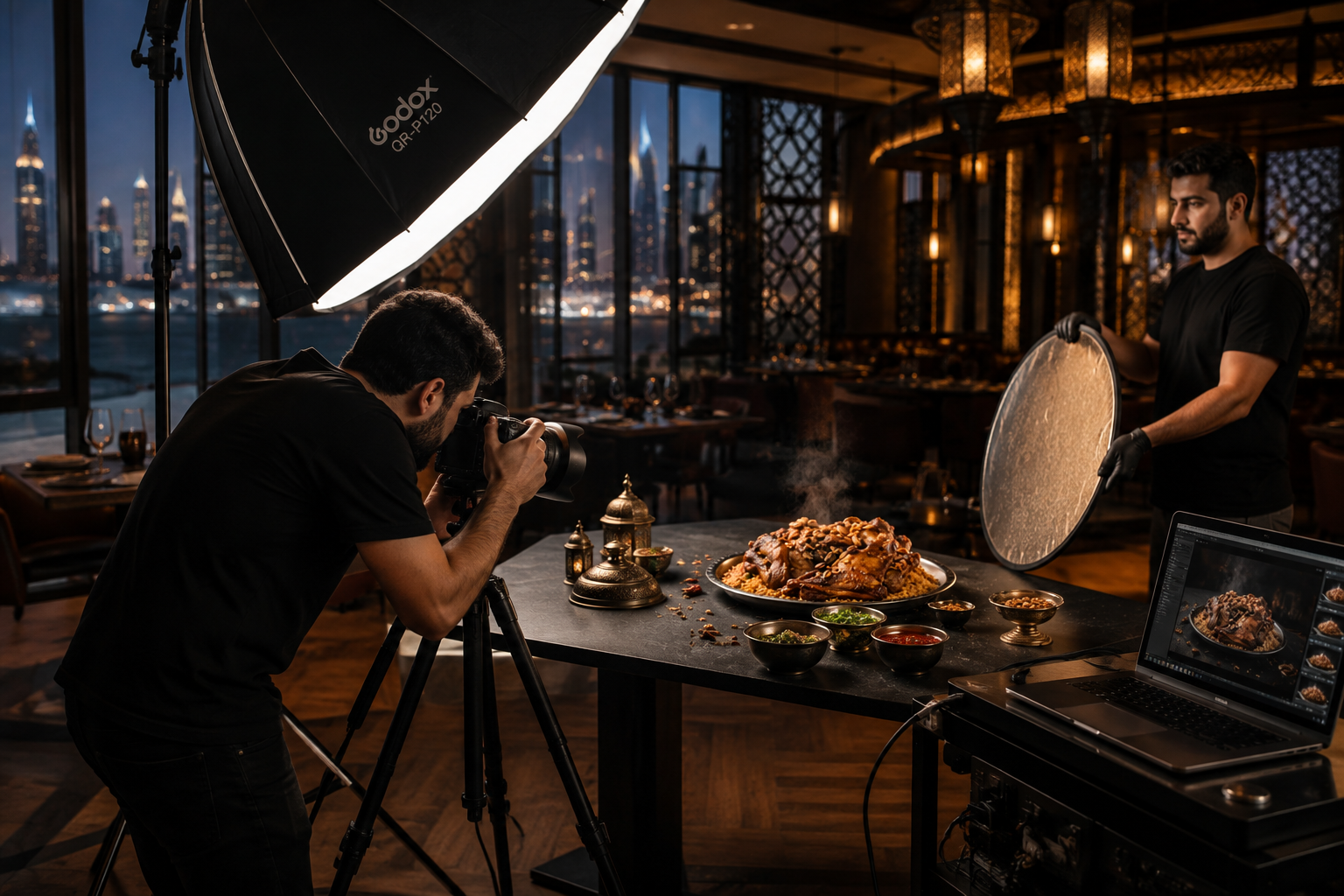
Food photography Dubai studios and freelancers have multiplied to meet this demand, but quality varies enormously. Strong commercial food photography isn't about a nice-looking plate on a white table — it requires food styling (often with a dedicated stylist using glycerine, torches, and tweezers to hold garnish placement), controlled lighting that makes sauces glisten without looking greasy, and an understanding of how images will be cropped on a delivery app thumbnail versus a full-width Instagram post.
Menu photography specifically needs a different approach than social content. Talabat, Deliveroo, and Careem NOW crop images into small squares, so dishes shot for delivery listings need bold, centred composition with minimal negative space — the opposite of the moody, off-centre styling that performs well on Instagram grids. Restaurants that use the same photoset for both channels consistently see lower delivery app click-through rates.
What a proper shoot actually covers
A well-planned shoot produces three distinct asset sets: hero images for the website and PR, square crops optimised for delivery platforms, and raw b-roll footage that a video editor can later cut into Reels. Booking these simultaneously with one crew, rather than commissioning separate photographers and videographers on different days, cuts cost by roughly 30–40% and keeps styling consistent across every channel.
Reels and Short-Form Video: Turning Scrolls into Reservations
Static photography still matters, but Reels and TikToks now generate the bulk of new-customer discovery for Dubai F&B brands. The formats that consistently perform: overhead "cheese pull" or sauce-drizzle close-ups shot on a macro lens, POV videos of a server delivering a showstopper dish to the table, and rapid-cut "what we ate at [restaurant name]" content filmed by micro-influencers rather than the brand itself.
Timing and pacing matter more than production value. The best-performing restaurant Reels in the UAE market cut every 0.8–1.2 seconds, front-load the most visually striking shot in the first two seconds before the algorithm decides whether to keep pushing the video, and end with a clear location tag and booking prompt in text overlay. Restaurants that outsource this to agencies experienced in the local scroll behaviour typically see 3–5x the reach of in-house attempts filmed on a staff member's phone.
User-generated content remains the highest-converting format of all. A short influencer collaboration — even a nano-influencer with 8,000–20,000 followers reviewing a dish authentically — often drives more direct reservations than a polished brand-produced ad, because UAE diners have grown skeptical of overly staged restaurant marketing.
CGI Food Advertising Dubai: When Real Photography Isn't Enough
CGI food advertising Dubai agencies now offer is increasingly used to solve problems real photography can't. A burger that visually collapses after ten minutes on set, a seasonal dish that needs to be marketed before the ingredients are even in season, or a drink that needs to look identical across fifty billboard and digital placements are all cases where 3D-rendered food outperforms a real shoot.
CGI also unlocks impossible shots: a slow-motion splash of sauce frozen mid-air, a cross-section of a burger showing every layer in perfect symmetry, or a rotating 360-degree hero shot for a delivery app banner. Built in tools like Blender or Cinema 4D, these renders are increasingly indistinguishable from photography when done by a specialist studio, and they give brands full control over lighting, garnish placement, and background — useful for campaigns that need to run across multiple markets or seasons without a reshoot.
The honest caveat: CGI works best blended with real photography, not replacing it entirely. Diners can sense when every single asset on a page looks artificially perfect, and restaurants that mix genuine table-side video with the occasional CGI hero shot for campaign visuals tend to maintain more trust than those that go fully synthetic.
Building a Restaurant Video Marketing UAE Strategy That Converts
Content without a distribution plan is wasted spend. A working restaurant video marketing UAE strategy starts with a monthly content calendar mapped against real business drivers: a new menu launch, Ramadan iftar packages, a brunch promotion, or a slow Tuesday that needs an offer pushed through paid social. Every piece of content should tie back to one of these commercial moments rather than being produced for its own sake.
Budgets vary by concept size. A casual café in a community mall might run on AED 8,000–15,000 a month covering four Reels, ongoing photography, and light paid boosting. A fine-dining venue in DIFC or on Palm Jumeirah competing for high-value reservations typically needs AED 25,000–50,000 monthly to fund quarterly CGI campaigns, monthly influencer collaborations, and consistent paid amplification on Meta and TikTok.
Paid distribution is non-negotiable once organic reach flattens. Meta Ads Manager campaigns geo-targeted within a 5–10km radius of the venue, paired with TikTok's Spark Ads boosting existing organic posts rather than building new ad creative from scratch, consistently deliver the lowest cost-per-reservation for Dubai F&B brands.
Platform-by-Platform: Where Dubai Diners Actually Discover Restaurants
Instagram remains the dominant discovery platform for mid-to-premium dining, with Reels, Stories highlights, and geo-tagged Explore page content driving the majority of first-time visits. TikTok has overtaken Instagram specifically for casual and trend-driven concepts — bubble tea, smash burgers, viral desserts — where the platform's food-discovery culture rewards novelty over polish.
Google Business Profile is underrated but decisive at the bottom of the funnel. Diners who've already decided to eat out and are searching "restaurants near me" convert based almost entirely on the photos and short videos attached to the GBP listing. Restaurants that upload fresh photos and Reels-style GBP videos weekly see measurably higher click-to-call and directions-request rates than those with stale, years-old listing photos.
YouTube Shorts and Snapchat play a smaller but growing role, particularly for reaching UAE national audiences and family dining decisions, where longer-form content — a two-minute restaurant tour or chef interview — still gets watched in full.
Working With a Food Content Agency Dubai: What to Expect
A capable food content agency Dubai operators can rely on should handle the full production chain in-house: food styling, photography, videography, editing, CGI where needed, and paid distribution — rather than outsourcing pieces to freelancers with no shared creative direction. This matters because consistency across every touchpoint (delivery app, Instagram grid, website, Google listing) is what builds a recognisable brand rather than a scattered collection of one-off shoots.
Expect a proper agency to start with a brand audit: reviewing existing photography quality, competitor content in the same category and neighbourhood, and current booking data to identify which dishes or moments actually drive revenue before a single shoot is scheduled. Agencies that skip straight to filming without this step tend to produce content that looks nice but doesn't move the metrics that matter — covers, average check size, and repeat visits.
Contract structures in Dubai typically run as monthly retainers covering a set number of shoot days, edited deliverables, and posting management, with CGI and larger campaign work quoted separately per project. Ask any prospective agency for actual before-and-after engagement or booking data from previous F&B clients — a serious food content team should have this readily available.
Measuring ROI: From Views to Covers
Views and likes are vanity metrics unless tied back to reservations. The metrics that actually matter for F&B content are: reservation platform traffic sourced from social (trackable via UTM links in bio and Story links), Google Business Profile "directions" and "call" clicks week-over-week, and — for delivery-heavy concepts — the click-through rate on menu photography inside Talabat and Deliveroo's own analytics dashboards.
Attribution isn't perfect in F&B — a diner might see a Reel on Monday and walk in on Saturday with no trackable link between the two. Restaurants that solve this run simple in-venue tracking: a server asking "how did you hear about us" logged into a shared spreadsheet, or a unique Instagram-only promo code, gives a rough but genuinely useful read on which content is actually filling tables versus just collecting likes.
The restaurants winning in Dubai's crowded market right now are the ones treating photography, video, and CGI as a single connected system rather than three separate line items — booking one team that understands how a shot needs to work on a billboard, a delivery app thumbnail, and a nine-second TikTok all at once.