For two decades, digital advertising in the UAE has meant bidding for attention on a results page: Google Ads at the top of a search, Meta Ads in a feed, TikTok Ads between videos. OpenAI Ads, also called ChatGPT Ads, breaks that model entirely. Instead of competing for a slot among ten blue links, brands now compete to be the single sponsored suggestion woven into a direct, conversational answer — and for Dubai businesses that move fast, this is the earliest and cheapest moment to learn the mechanics before the auction gets crowded.
What OpenAI Ads Actually Is
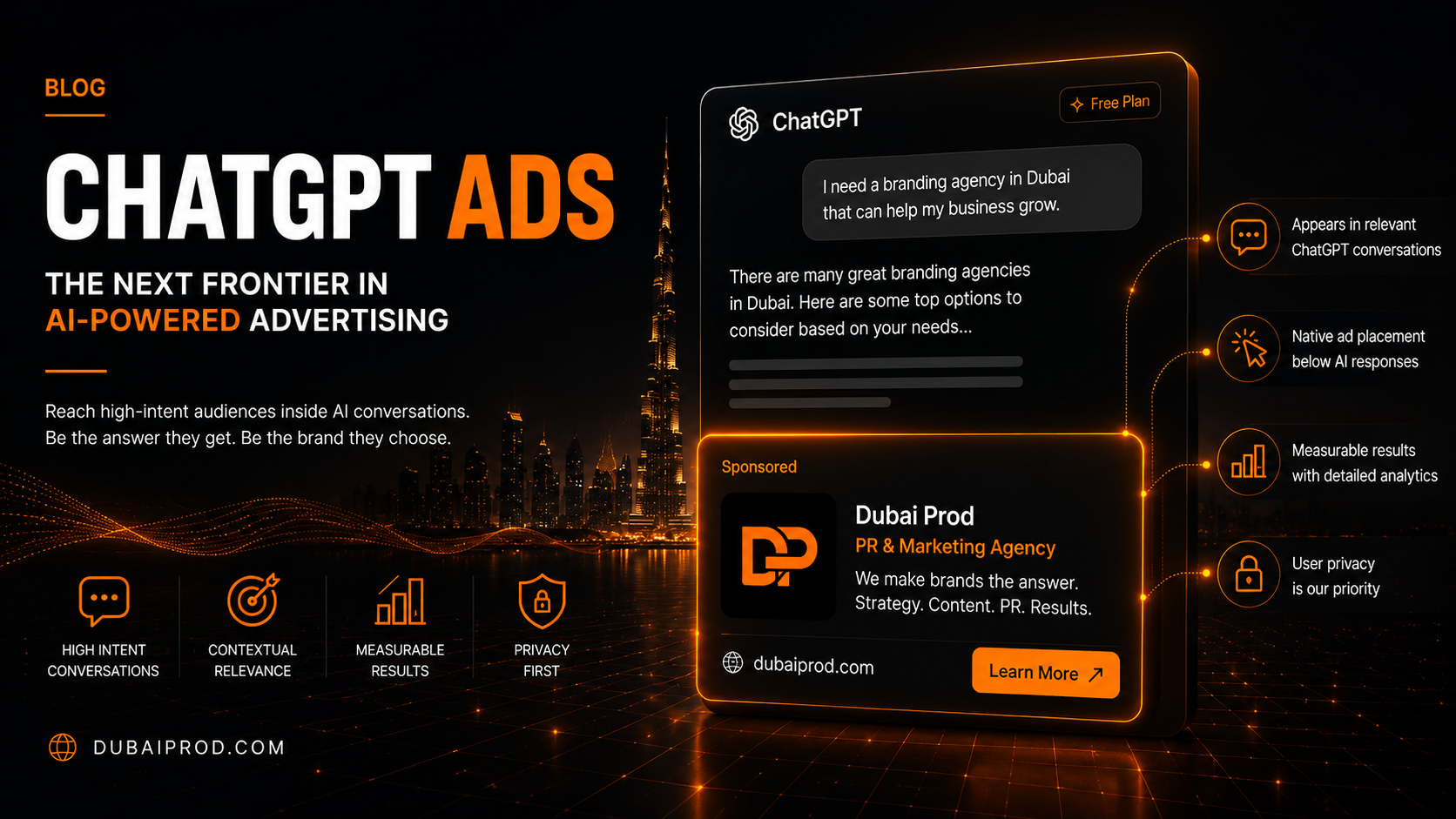
OpenAI Ads is a native advertising unit inside ChatGPT that shows a sponsored product, service, or link as part of the assistant's response to a user's question. A user asking ChatGPT for "best CrossFit gyms in Dubai Marina" might receive a normal synthesised answer plus a clearly labelled sponsored recommendation, rather than a page of ten competing listings.
This is a fundamentally different advertising surface. There is no results page, no scroll, no ten blue links to skim past. There is one conversational answer, and a brand is either woven into it or it isn't. That single-slot dynamic is the single biggest thing UAE marketers need to internalise before they touch a budget.
How ChatGPT Ads Differ From Google Ads
Google Ads works on keyword auctions: an advertiser bids on a search term, pays per click, and competes against several other visible ads on the same page. Users see multiple options, compare, and choose. The entire model assumes browsing behaviour.
ChatGPT Ads assumes trust behaviour instead. A user asking ChatGPT for a recommendation is often looking to skip the comparison step entirely — they want the assistant to have already done the shortlisting. That means the sponsored placement has to feel like a natural extension of a helpful answer, not an interruption to one. Ads that read like traditional banner copy will underperform badly in this format; ads that read like a genuinely relevant recommendation, backed by real specificity (a price range in AED, a location, a specific service), will earn the click.
Why Relevance Now Outweighs Bid Size
In Google's auction, a large enough bid can force visibility even for a mediocre landing page. Early signals from OpenAI's rollout suggest the opposite is true here: relevance to the user's actual intent, and the underlying quality of the brand's public content, weighs heavily on whether an ad gets shown at all. A Dubai retailer with thin, generic web copy will struggle to win placement even with a healthy budget, because the system has less confidence in matching that brand to a specific question.
Why This Matters for Dubai and UAE Businesses Right Now
ChatGPT has become a default research tool for a meaningful share of UAE consumers — comparing schools, clinics, restaurants, real estate agents, and service providers before they ever open Google. Businesses that assume this traffic is invisible or unmonetisable are already behind. OpenAI Ads is the mechanism that turns that conversational discovery into a paid channel, and the market that adapts early captures disproportionate share before competitors even understand the format exists.
There is also a structural advantage for smaller and mid-sized Dubai businesses here. Google Ads auctions in competitive verticals like real estate, healthcare, and hospitality in Dubai have become expensive, with cost-per-click in some categories exceeding AED 40–60. A new, less contested ad surface — even a nascent one — offers a rare window where budget efficiency is likely to be higher simply because fewer advertisers are bidding.
How Sponsored Placement Inside ChatGPT Actually Works
Based on OpenAI's public rollout details, sponsored content appears contextually, tied to the intent of the question rather than to a fixed keyword list. The system evaluates what the user is actually trying to accomplish — booking a service, comparing products, finding a location — and surfaces a relevant sponsored option alongside or within the generated answer, clearly marked as advertising.
This means the traditional keyword list that drives a Google Ads campaign is far less central here. What matters more is whether OpenAI's models can confidently associate a brand with a specific, well-defined intent. That confidence is built from the same signals that already matter for AI visibility more broadly: structured, factual, entity-clear content that a language model can parse and trust.
GEO and AEO Are the Real Prerequisite
Before any Dubai brand spends a single dirham on ChatGPT Ads, there is groundwork that determines whether that spend will work at all. Generative Engine Optimization — structuring a website, schema, and content so AI systems can read, verify, and cite it — is what makes a brand eligible to be matched with the right questions in the first place. A business that has never optimised for how ChatGPT reads the web is starting several steps behind one that has.
Answer Engine Optimization sits alongside it. Content built as direct, extractable answers to real customer questions — clean headings phrased as questions, 40–60 word direct answers, consistent entity naming across the web — is exactly the kind of content that gives an AI system enough confidence to recommend a brand organically, and by extension, enough confidence to serve that brand's paid placement too. The two are not separate strategies; the organic groundwork and the paid opportunity are built from the same foundation.
Third-Party Corroboration Still Decides Trust
As with organic ChatGPT citations, third-party corroboration matters. A brand that only talks about itself on its own website, with no independent reviews, press coverage, or directory listings reinforcing the same facts, gives the model less reason to trust it. UAE businesses investing in PR and media coverage now are quietly building the trust signal that later makes both organic AI visibility and paid ChatGPT placement more achievable.
What Early Advertisers Should Expect
Budgets, targeting controls, and reporting dashboards for OpenAI Ads are still maturing, and Dubai advertisers should plan for a testing mindset rather than a scaled media plan. Early platforms of this kind typically reward small, tightly monitored pilot budgets — a few thousand AED run over several weeks — rather than large upfront commitments, simply because the targeting mechanics, measurement, and attribution models are still being refined by the platform itself.
Measurement will also look different from a standard Google Ads dashboard. Click-through metrics matter less when the ad is embedded in a single conversational answer rather than a comparison page; what will matter more is whether the sponsored mention drove a genuine action — a booking, a call, a site visit — tracked through UTM parameters and conversion pixels adapted for this new referral source. UAE marketing teams should build these tracking foundations into their analytics now, well before spend scales.
Risks and Unknowns Worth Planning For
No advertiser should treat ChatGPT Ads as a guaranteed channel yet. Placement volume is limited, eligibility criteria are still evolving, and OpenAI has been deliberately cautious about how aggressively it monetises the assistant experience, given the risk of eroding user trust in ChatGPT's answers. Budgets should be sized accordingly — this is R&D spend with upside, not a core acquisition channel to build a 2025 media plan around just yet.
There is also a reasonable chance that eligibility and format will shift materially as the programme scales, the way Google's own ad formats evolved dramatically between 2000 and 2010. Dubai brands that build genuinely strong GEO and AEO foundations now are protected against that uncertainty, because that groundwork pays off regardless of exactly how the paid product evolves.
How Dubai Prod Prepares Brands for This Shift
Dubai Prod treats OpenAI Ads readiness as an extension of the AI search work the agency already runs for UAE and GCC clients — GEO audits, AEO content architecture, schema markup, and llms.txt configuration that make a brand legible to AI systems in the first place. That foundation is what determines whether a future ChatGPT Ads campaign has anything credible to build on.
On the paid media side, the agency's Google Ads Manager, Meta Ads Manager, and TikTok Ads expertise translates directly into disciplined test-and-learn campaign structures — the same conversion tracking, UTM discipline, and iterative budget allocation that made early TikTok Ads and early Meta Reels placements profitable for clients before those formats matured. Brands that want a first-mover position in AI-native advertising, without gambling an entire quarter's media budget on an unproven surface, are exactly who this preparation work is built for.